
Internal colonialism’s principal referents are remarkably disparate: the colonisation of peripheral regions during the formation of nation states, the exploitation and oppression of indigenous populations in formally post-colonial states, and the persistence of colonial-era racial subjugation in a post-colonial context. ‘Colonial’ in each case refers not narrowly to the conquest of an overseas territory by a metropolitan state but broadly to economic domination coupled with the (usually racialised) operation of power.
Early references to internal colonialism were made by the fascist economist Mihail Manoilescu to refer to exploitation of rural Romania by Jew- and German-dominated towns,1 and by the communist economist Maurice Dobb to describe the domination by America’s Eastern seaboard over its agricultural hinterland.2 In later decades, the phrase became redeveloped by leftists and Black nationalists, to describe situations in which a ‘core’ ethnic or ‘racial’ group reproduces colonial-style domination and extraction, long after the end of formal imperial rule and/or within the same territory.
Internal colonialism has been identified, inter alia, in the treatment of Bosnia-Herzegovina under Austro-Hungarian rule,3 Kurds in Turkey, Tamils in Sri Lanka, Papuans in Indonesia, and the non-Manilan and non-Burman peripheries in the Philippines and Myanmar respectively. It has been applied to the plight of the Uyghur people in China, subjected to economic extractivism, with coerced labour, mass internment, and forced programmes of cultural assimilation, and to that of forest-dwellers in India, where, “in hideous mimicries of the settler-colonial treatment of Indigenous peoples,” ever more forest areas are being cleared for the mining and tourism industries.4
Of the three principal variants, let us look, firstly, at internal colonialism within nation-state formation. The insight here is that something broadly ‘colonial’ operates within virtually any form of state formation, whether imperial, national or otherwise. A case in point is ancient Rome: some of its distant territories (such as Britannia) began as colonial military outposts before becoming integrated provinces of the empire. Can we read nation formation as a similar process? Michael Hechter famously proposed that we can: “Nation-building in its earliest stages,’ he writes in Internal Colonialism: The Celtic Fringe in British National Development, “might better be thought of as empire-building.”5 The distinction is gauged simply by legitimacy—the state form is a nation-state where its authority “is perceived to be legitimate by all its subject social groups.” Otherwise it’s an empire.6
Hechter’s central question concerns the intersection of ethnic identity formation with state expansion in a context of uneven economic development. As influences he cites, inter alia, Lenin and Gramsci. In The Development of Capitalism in Russia, Lenin, drawing on narodnik thought, had grouped under the rubric of internal colonisation several processes: the consolidation of Russia’s dominium over its borderlands; settler colonialism within the Tsarist Empire (for example Russian peasants establishing farms in Bashkiria); the expansion of capitalist trade and markets outward from Russia to its peripheries; and the economic domination of peripheries by the core — the former producing primary goods in exchange for manufactures from the latter.7 A variation on the theme was advanced by Gramsci. He coined “internal colonies” to refer to relationships such as, in Italy, the subordination of the agrarian Mezzogiorno to the industrial North.8
Like his precursors, Hechter’s concern is with the politics of uneven development. A student of Immanuel Wallerstein, he applied a core–periphery model to the genesis of the British nation, arguing that England’s domination of the Celtic lands evinces parallels to the experience of Third World colonies, in that they were “used instrumentally by the metropolis … as a source for primary or extractive products” to supply metropolitan industries and consumers.9 The “colonial process by which English institutions and markets expanded into the Celtic fringe,” he proposed, had generated uneven development and a “cultural division of labour, [with] high status occupations reserved for those of metropolitan culture, while those of indigenous culture cluster at the bottom.”10 In Scotland, Wales and Ireland, metropolitan-indigenous polarisation provoked the formation of “reactive” ethnicities.11
Hechter’s thesis faced criticism. Unlike to Ireland, England’s relationship to Scotland and Wales is implausibly depicted as ‘colonial,’ in part because it developed prior to nation-formation in those countries. England was more differentiated than he allows (including Cornwall, its own Celtic fringe), and Wales and Scotland likewise, notably the cleft between Scotland’s Highlands and Lowlands. Welsh and Scots were heavily involved in British imperial enterprises, and Hechter in general overlooks the British empire. He does briefly consider postwar immigrants from former British colonies, but predicts, erroneously, that they will before long “lay claim to the mantle of being internal colonies.”12 Underlying most of these shortcomings is that Hechter operates with a rough definition of colonialism – essentially, ethnic division of labour plus political domination – and neglects to consider the role of capitalism in generating nationalism even as it was transforming the nature of colonialism.
Internal colonialism’s second variant is where a settler colony establishes itself as a nation state but either continues the colonisation process vis-à-vis indigenous peoples or dominates those peoples in a racialised form evocative of colonial rule. In Peru, José Carlos Mariátegui’s description of “the Indigenous problem” can be read as internal colonialism avant la lettre.13 The liberation of Latin America from Iberian rule, he argued, had not freed Indigenous peoples. Power instead centred on creole elites, who maintained and modernised colonial systems of extraction and racial domination.14 Later Latin American authors went on to deploy the phrase internal colonialism, most influentially when in 1963 the Mexican sociologist Pablo González Casanova described the Indigenous question as “essentially a problem of internal colonialism.”15 Following Casanova, his compatriot Rodolfo Stavenhagen theorised relations between Ladinos and the Maya Indians of Chiapas and northern Guatemala as internal colonialism.16
The case of Brazil has been widely discussed too, with the treatment of the Amazonian interior treated as a form of internal colonisation, with the state marshalling private capital from the metropolitan centre and settler colonists to push the frontier of ‘civilisation’ further into the interior, converting Amazonia into a resource hinterland while offering minimal political incorporation to its Indigenous and traditional communities (ribeirinhos, and quilombolas — descendants of fugitive slaves).17
From the perspective of Indigenous peoples, ever since their “first contact with the ‘white men’ in the seventeenth century,” a colonisation process has been ongoing, initially featuring incursions from ‘bandeirante’ (slave hunters), as well as Jesuit missionaries and cattle ranchers — the prototype of Brazil’s infamous power triad of bala-boi-bíblia [bullet-bull-bible].18 Brazil’s independence from Portugal did not materially alter the onslaught: the drive to eliminate indigenous peoples continued, as did the mass enslavement of Africans and the reckless plundering of the natural environment. Internal colonisation accelerated in the mid-twentieth century, with highway construction and extractivism under the Vargas presidency, and later under the military dictatorship of 1964-85, its settler-colonial ethos summed up in the slogans “A land without men for men without land” and its bovine-colonial pendant, “Amazonia will be colonized by the hooves of cows.”
The discussions above have highlighted scholarly contributions, mainly sociological. But internal colonialism has also featured in political debates, nowhere more than in South Africa. There, the Communist Party (SACP) used ‘internal colonialism’ (later adapted to ‘colonialism of a special type’) to describe a peculiarity of apartheid, namely that “the colonial ruling class with its white support base, on the one hand, and the oppressed colonial majority, on the other, are located within a single country.”19 This thesis was deployed in support of the SACP’s — and the ANC’s — dual-phase strategy of socialist transition: first, activists should mobilise against the apartheid system, aiming to dismantle internal colonialism through ‘democratic revolution.’ Only then should socialism be put on the agenda. Critics to their left advanced a different diagnosis of the apartheid system, using terms such as ‘racial capitalism,’ cautioning that the ‘internal colonialism’ thesis “undermined the essentially working-class nature of the South African struggle and introduced a mechanical two-stage approach.”20
The third variant of internal colonialism, close in nature to the second, describes scenarios where colonial-era racial subjugation persists within an ostensibly post-colonial context. The USA, for example, identified as a postcolonial state, even as it expropriated indigenous territory, invaded and annexed parts of Mexico, and enslaved African people. African-Americans, argued sociologist W.E.B. Du Bois in the interwar era, occupied a social position analogous to colonised peoples elsewhere: a cheap, coerced workforce, politically disenfranchised and racially stigmatised.21 In the same period, a more explicitly political formulation emerged from the US Communist movement. In what became known as the ‘Black Belt’ thesis, Black people in the Deep South were described as an oppressed nation-within-the-nation, subject to colonial conditions of land dispossession and super-exploited labour. Their strategy of resistance, it followed, should take the form of national liberation, including territorial secession.
In the 1960s, during a worldwide social movement upsurge in which anti-colonialism played a central role, usage of ‘internal colonialism’ soared in the US. Black militants and Chicanos used it to emphasise that their oppression was institutional and rooted in historical colonialism, and to compare their oppression – poverty, illiteracy, slums, etc – to that of impoverished racialised people in colonised nations.22 Political leaders such as Stokely Carmichael (Kwame Ture) of the All-African People’s Revolutionary Party described ghettos as “internal colonies” shaped not by formal colonial administration but nonetheless by external control, economic extraction, cultural denigration, and confinement enforced through policing. The phrase symbolised the connection between US Black militants and the global anti-colonial movement.23
As in South Africa, applying ‘internal colonialism’ to the US is not unproblematic. It tends to play down stratification within the black community.24 The distinction between colonised and immigrant minorities is hard to sustain. And if its telos was national liberation, questions arise concerning the relationships among the various ‘colonised’ communities. For example, how would a liberated Black nation-state in the US South engage Choctaw and other First Nation claims to the same territory?25 For many activists, its use is tempered by awareness that the colonial analogy is imperfect, even in some respects hyperbolic, but that the analogy may assist in an urgent strategic sense, in insisting that the scandal of racialised exploitation is not safely consigned to history but persists in the present, and in linking that knowledge to historical movements of emancipation.
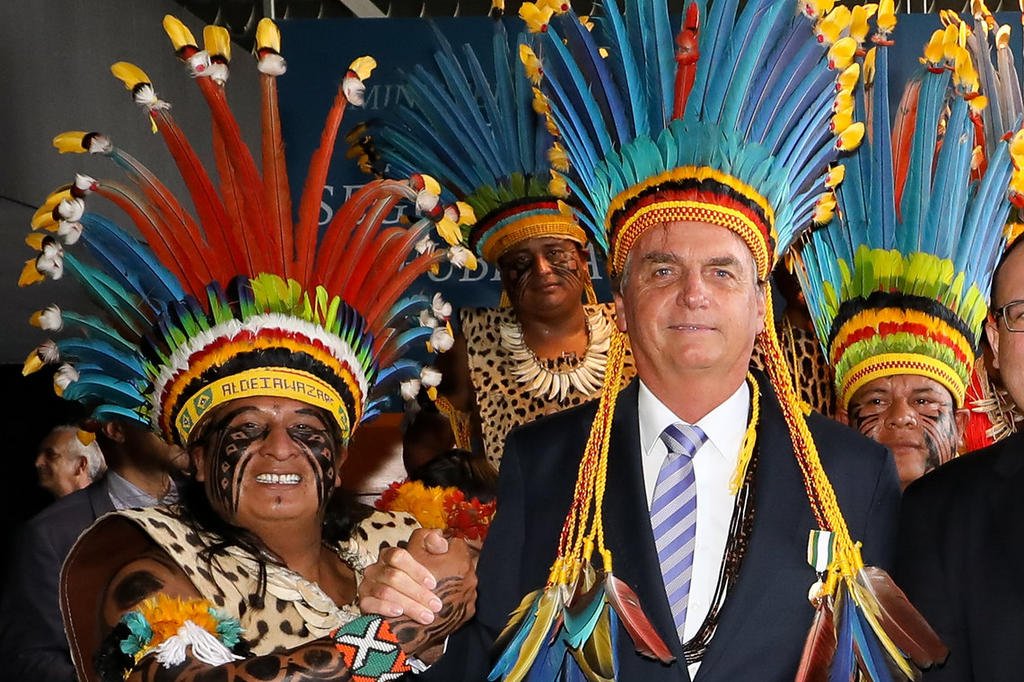
Former President Jair Bolsonaro (PL) wore an Indigenous headdress while receiving the Indigenous Merit Medal. Photo: Clauber Cleber Caetano/PR
References
- Love (1989).
- Dobb (1937) p.247.
- Donia (2015).
- Ghosh (2022) p.196.
- Hechter p. 65.
- Hechter p. 60.
- Lenin, 1899, pp.593-595.
- Gramsci p.369.
- Hechter p.147.
- Hechter pp. 342, 316.
- Hechter p. 30.
- Hechter p. 351.
- Gonzalez, p.78
- Mariátegui, 2021
- Quoted in Bibha and Laó-Montes (2026)
- Quoted in Ramón Gutiérrez (2004) ‘Internal Colonialism: An American Theory of Race,’ Du Bois Review: Social Science Research on Race, 1(2): 281-295.
- For discussion and references, Dale (2019).
- Dale (2019).
- SACP (1989) The Path to Power, https://www.sacp.org.za/docs/history/1989/power1989.html
- Cronin (2026).
- Du Bois p.237
- Gutiérrez.
- Gutiérrez.
- Burawoy.
- Levenson.
Bibliography
Upasana Bibha and Agustin Laó-Montes (2026) ‘The Multiple Lives of Internal Colonialism,’ Sociological Forum, Online publication date 7 July 2026.
Michael Burawoy (1974) ‘Race, Class and Colonialism,’ Social and Economic Studies, Vol. 23, No. 4, pp. 521-550.
Jeremy Cronin (2026) ‘The South African Communist Party and the negotiated transition to democracy’, Review of African Political Economy, Online publication date 23 April 2026.
Gareth Dale (2019) ‘Amazon Burning,’ https://www.researchgate.net/publication/354694813_Amazon_burning
Maurice Dobb (1937) Political Economy And Capitalism Some Essays In Economic Tradition, Routledge.
Robert Donia (2015) ‘Bosnia-Herzegovina under Austro-Hungarian Rule,’ in Clemens Ruthner et al., eds, WechselWirkungen. Austria-Hungary, Bosnia-Herzegovina, and the Western Balkans, 1878–1918, Peter Lang.
W.E.B. Du Bois (1935) Black Reconstruction in America, Harcourt, Brace.
Amitav Ghosh (2022) The Nutmeg’s Curse: Parables for a Planet in Crisis, John Murray.
Mike Gonzalez (2019) In the Red Corner: The Marxism of José Carlos Mariátegui, Haymarket.
Antonio Gramsci (1995) Further Selections From the Prison Notebooks, Lawrence & Wishart.
Ramón Gutiérrez (2004) ‘Internal Colonialism: An American Theory of Race,’ Du Bois Review: Social Science Research on Race, 1(2): 281-295.
Michael Hechter (1977) Internal Colonialism: The Celtic Fringe in British National Development, 1536-1966, University of California Press.
Sam Klug (2025) The Internal Colony: Race and the American Politics of Global Decolonization, The University of Chicago Press.
Vladimir Lenin (1960 [1899]) Collected Works Volume 3: The Development of Capitalism in Russia, Progress Publishers.
Zachary Levenson and Sam Klug (2025) ‘The Politics of Colonial Comparison: Interview With Sam Klug,’ Spectre, https://spectrejournal.com/the-politics-of-colonial-comparison/
Joseph Love (1989) ‘Modeling Internal Colonialism: History and Prospect,’ World Development, Vol. 17, No. 6, pp. 905-922.
José Carlos Mariátegui (2021) Selected Works, edited by Christian Noakes, Iskra Books.
