
Elia Ayoub is the Encyclopaedia Lead at the Decolonial Centre. He is a Lebanese-Palestinian researcher, writer, journalist and historian focusing on anti-authoritarianism, internationalism and alternative futurities. He hosts the podcast The Fire These Times and writes the Hauntologies newsletter. He’s been published in 972Mag, Shado Mag, Red Pepper, Al Jazeera, New Internationalist, Lausan Collective and Mangal Media, among others. He lives in Brighton, UK.
The Jewish Labour Bund, hereby referred to as the Bund, was a socialist party and movement in Eastern Europe “whose tenets were humane, socialist, secular, and defiantly Jewish.”1
Founded in Vilna (modern Vilnus, Lithuania)2, then part of the Russian empire, as the General Jewish Labour Bund in Lithuania, Poland and Russia (Yiddish: Yiddish: אַלגעמײנער ייִדישער אַרבעטער־בונד אין ליטע, פּױלן און רוסלאַנד, romanized: Algemeyner Yidisher Arbeter-bund in Lite, Poyln un Rusland), the Bund was rooted in “working-class solidarity and subaltern pride.”3 Bundists stood out for their desire to fight authoritarianism and antisemitism without compromising their Jewish identity in an empire which had institutional anti-Semitism and had confined Jews to the Pale of Settlement. From battling the Tzar to resisting pogroms, the Bund would even help lead the Warsaw Ghetto uprising against the Nazis.
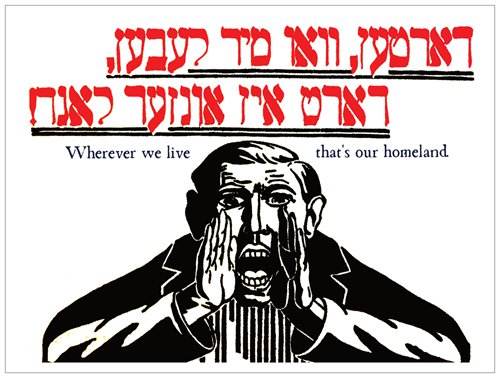
They promoted Doikayt4, or here-ness, in direct contrast to the there-ness of Zionisn which promoted a foreign land, Palestine, as the Jewish homeland-to-be. They held that being part of a millenium-old history – that of Eastern European Jews – “gave them as legitimate a claim to those lands as that of any antisemitic gentile.”5
The Bund viewed Zionism as a “reactionary, bourgeois nationalist movement and insisted, as one translation of a 1931 song put it, that “we’d rather stay in the diaspora, and fight for our liberation.””6 Indeed, the Bund believed that the diaspora was home, and that Eastern European Jews were to be celebrated as a people with their own rich, Yiddish-speaking culture. For example, the Bundist theorist Vladimir Medem advocated for a “state of nationalities”7 in independent Poland instead of the nation state, meaning one “of all peoples living on its territory, not a state of and for ethnic Poles with secondary rights for other nationalities.” 8
Legacy of the Bund Today
Despite being as old as the World Zionist Congress – which was founded by Theodor Herzl in Basel, Switzerland in 1897 – and being “one of the largest socialist organisations in the Russian empire” with 30,000 active members in 19059, the legacy of Bundism is today largely obscured. The decline of the Bund follows the same trend as the decline of the Yiddish language it embraced: Up to 85% of Jews killed in the Holocaust, or Khurbn10 Eyrope (“the European cataclysm” in Yiddish) were Yiddish speakers11 and many of them were Bundists, such as Abraham Blum12 and Maurycy Orzech13, both killed shortly after taking part in the Warsaw Ghetto uprising.14
In recent years, the hegemony of Zionism has been challenged by Jewish activists. The 2014 Israeli war on Gaza catalysed the rise of groups like Jewish Voice for Peace (JVP) providing alternatives for Jews who reject the argument that safety from antisemitism requires an ethnostate defending Jewish supremacy over Palestinians in Israel-Palestine. Instead, the philosophy of “safety through solidarity,”15 namely the idea that fighting antisemitism is best practiced through solidarity with marginalised groups in the West, is being promoted by many more Jewish activists and groups.
The erasure of Bundism was a victory for authoritarianism but “history,” Molly Crabapple writes, “is never settled” and today “the Bund’s anti-Zionism, which had so marginalized them during the long decades of Israeli communal dominance, would lead a new generation to embrace them.”16 This generation is seeking to “live out the values of Doikayt” by “building an anti-fascist movement alongside the people being persecuted just as our ancestors were — immigrants, trans people, student protestors.”17 Through Doikayt, they seek to push “the boundaries of imagining Jewish self-determination, championing a world where we could exist diasporically alongside a plurality of other peoples.”18
References
Molly Crabapple, “Here Where We Live is Our Country: The Story of the Jewish Bund,” (Bloomsbury, 2026), xx.
Yiddish Book Center, “Weekly Reader: The General Union of Jewish Workers.”
Molly Crabapple, “Here Where We Live is Our Country: The Story of the Jewish Bund,” (Bloomsbury, 2026), xx.
Jews For Racial & Economic Justice, “Moment Magazine: Doikayt – The Jewish Left Is Here,” (2024).
Alex Lantsberg, “New Lessons for Old Truths: Molly Crabapple’s “Here Where We Live Is Our Country,” (Der Spekter, 2026)
Shane Burley and Ben Lorber, “Safety Through Solidarity: A Radical Guide to Fighting Antisemitism,” (First Melville House Printing, 2024), 314
Vladimir Davidovich Medem, “The Worldwide Jewish Nation.” Jews & Diaspora Nationalism: Writings on Jewish Peoplehood in Europe & the United States. (Waltham: Brandeis Univeristy Press, 2012)
Madeline Atkin Cohen, “Here and Now: The Modernist Poetics of Do’ikayt” Dissertation, 2016
April Rosenblum, “The Jewish Bund”, The International Encyclopedia of Revolution and Protest, 8 Volume Set: 1500 to the Present, Immanuel Ness, ed. (Malden, MA: Wiley-Blackwell, 2009), 1966-1988
Hannah Pollin-Galay, “Occupied Words: What the Holocaust did to Yiddish,” (De Gruyet Brill, 2024)
Avinoam Patt, ‘Review of Occupied Words: What the Holocaust Did to Yiddish by Hannah Pollin-Galay‘, In geveb: A Journal of Yiddish Studies (2025)
- Also known as Abrasza Blum
Nom de guerre: Janczyn
Marek Edelman, “The Ghetto Fights: Warsaw 1941-1943,” (Bookmarks, 1990)
Shane Burley and Ben Lorber, “Safety Through Solidarity: A Radical Guide to Fighting Antisemitism,” (Penguin Random Press, 2024)
Molly Crabapple, ‘Here Where We Live is Our Country: The Story of the Jewish Bund”, (Bloomsbury, 2026), 380.
Sarah Norr, “Doikayt in Oakland: Putting the Pieces Together,” (Der Spekter, 2026).
- Sam Sherman, “To Hold the Line: Sumud, Doikayt, and the Syntax of Shared Struggle,” (Der Spekter, 2024)
