
Elia Ayoub is the Encyclopaedia Lead at the Decolonial Centre. He is a Lebanese-Palestinian researcher, writer, journalist and historian focusing on anti-authoritarianism, internationalism and alternative futurities. He hosts the podcast The Fire These Times and writes the Hauntologies newsletter. He’s been published in 972Mag, Shado Mag, Red Pepper, Al Jazeera, New Internationalist, Lausan Collective and Mangal Media, among others. He lives in Brighton, UK.
Reviewed by Justin Salhani, Lebanese journalist, on 9 June 2026.
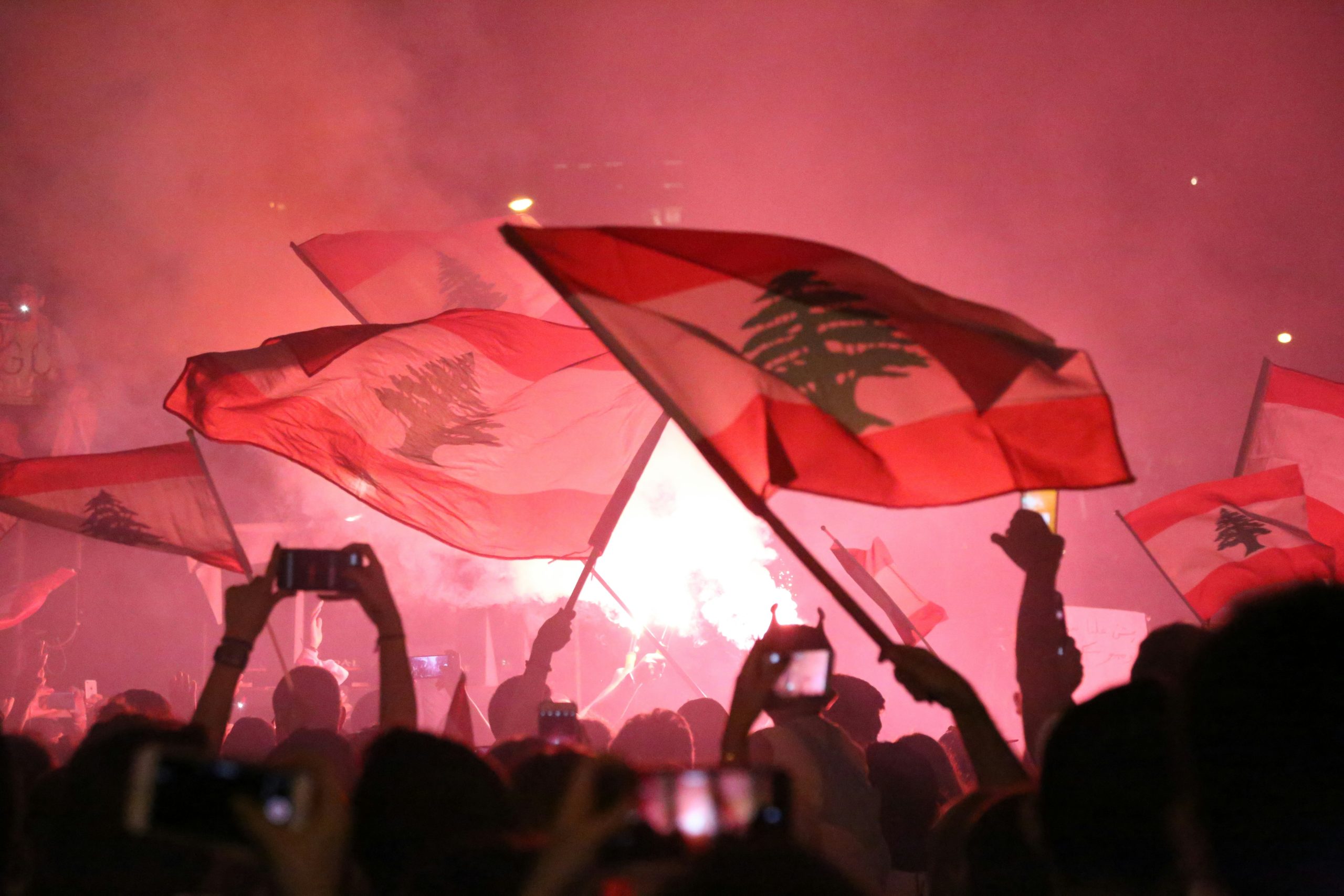
The 2019 uprising in Lebanon, locally known as Hirak (movement) or Thawra (revolution), was a series of decentralised protests that dominated Lebanese politics in the final months of 2019 and beginning of 2020.1 It was one of many protests that year, part of a global wave of uprisings that rocked places as diverse as Chile, Iraq, Hong Kong, Sudan and Haiti.
Initially triggered on October 17th by grievances over badly managed wildfires2 and a government proposal to tax free phonecall services,3 the protests soon evolved into a more widespread denouncement of corruption, the entirety of the postwar status quo, here referring to the period since the end of the 1975-1990 civil war, and of sectarianism, the power-sharing status quo in Lebanon in which positions of power are divided up according to sectarian calculations.4
Eight years after the eruption of the Arab Spring throughout the SWANA region in countries such as Syria, Egypt, Tunisia, Bahrain, Yemen and Libya, protesters in Lebanon took up popular chants such as ash-shab yurid isqat an-nizam (“the people want the downfall of the regime”)5 with an-nizam often replaced by al-ta’ifyyeh (sectarianism). This system, in place since the founding of the modern Lebanese republic in the 1940s and with roots in the Ottoman and French colonial periods, was widely seen as responsible for corruption and the absence of adequate state services.6 As state power is distributed along sectarian and patriarchal lines, this has led to the growth of primarily cis-male and sectarian elites that serve as gatekeepers of ‘their’ own communities, becoming the defacto providers of jobs and services, or the middlemen who facilitate this clientalist economy.7 Furthermore, the dominance of personal status laws that limit crucial issues such as marriage, divorce and inheritance within the various sects’ religious courts has meant that women and members of the LGBTQ community are legally subordinated to their cis and straight male relatives.8
In other words, sectarianism and patriarchy are two of the mechanisms through which capital accumulates and power is consolidated in Lebanon. While anti-capitalist and anti-patriarchal politics were rarely explicit throughout the uprising, various groups have attempted to make them more pronounced through direct participation in the uprising and in some cases organising separate marches.9 The decentralised nature of the uprising has meant that otherwise underrepresented groups of citizens and residents were given greater access to public squares and discourses. This was in sharp contrast to a previous uprising in 2015 which, while sharing similar grievances as 2019, was largely dominated by a self-appointed committee10 that was quickly targeted, co-opted11 and eventually rendered ineffective.12
Despite the state’s repression, protesters throughout the country set up encampments and populated them with “soup kitchens, free psychiatric clinics, piazzas for regular public debates, performance spaces, and meeting areas, among other functions.”13 These were tactics consciously set up to counter the sectarian divide and conquer strategy that segments of the ruling class was deploying.14 For example, in Tripoli, northern Lebanon’s de-facto capital and a Sunni-majority city, protesters chanted their solidarity with the Shia-majority south,15 leading Lebanese novelist Elias Khoury to call Tripoli “the light of the revolution.”16
In the end, the thawra was largely suppressed by a combination of state violence, a worsening economic crisis and, eventually, by the COVID-19 pandemic in 2020, among other reasons.17 While the impact of the uprising was immediately felt in the downfall of the then-ruling coalition,18 if temporary,19 its long-term impact remains to be seen. The 2022 general election brought in more independent MPs than ever before, a change that was credited to the thawra.20 It can also be argued that, for the first time, people in Lebanon were offered a vision, however brief, of what a post-sectarian country could look like weakening the hegemonic hold that the establishment parties have had on the country for decades.21
References
- Rima Majed and Jeffrey Karam (editors), The Lebanon Uprising of 2019: Voices from the Revolution, Bloomsbury, 20 October
2022. ISBN: 9780755644421; Rima Majed and Lana Salman, Lebanon’s Thawra, 16 December 2019, MERIP,
https://archive.is/F5A2Z - Timour Azhari, Lebanon wildfires: Hellish scenes in mountains south of Beirut, 16 October 2019, Al Jazeera,
https://archive.is/IrSFD - Amnesty International, Lebanon’s October 2019 protests weren’t just about the ‘WhatsApp tax’, 20 October 2021,
https://archive.is/PcAxY - Judy El Baba, Roots of Lebanon’s Sectarian Politics: Colonial Legacies of the French Mandate, Politikon: The IAPSS Journal of
Political Science 24, 30 November 2024, https://doi.org/10.22151/politikon.58.2 - Deen Sharp and May Farhat, The October 2019 Uprising, Lebanon Unsettled,
https://lebanonunsettled.org/archive/the-october-2019-uprising - Samir Makdisi and Youssef El-Khalil, Lebanon: The Legacy of Sectarian Consociationalism and the Transition to a Fully-fledged
Democracy, Issam Fares Institute for Public Policy and International Affairs Working Paper Series #14, March 2013
https://www.aub.edu.lb/ifi/Documents/20130301samir_makdesi_youssef_khalil_rapp_wp.pdf - Rima Majed, Why the Lebanese support the same sectarian leaders, 6 April 2017, https://archive.is/ox03a
- Maya Mikdashi, Sex and Sectarianism: The Architecture of Lebanese, Comparative Studies of South Asia, Africa and the Middle
East, Volume 34, Number 2, 2014, pp. 279-293 Citizenship https://archive.is/L4fX2 - UN Women, Understanding the Role of Women and Feminist Actors in Lebanon’s 2019 Protests, 13 December 2020,
https://archive.is/7crNa - Full disclosure: I was on the committee as part of the media relations subcommittee.
- Stephany Daher, The Politics of Contentious Action: Case-Study of the Lebanese “You Stink” Movement, Siyasat Arabiya, Issue
30, July 2019 https://archive.ph/Gwu36 - Marwan M. Kraidy, Trashing the sectarian system? Lebanon’s “You Stink” movement and the making of affective publics, Zhejiang
University, 1 March 2016 https://doi.org/10.1177/2057047315617943 - Mona Fawaz and Isabela Serhan, Urban Revolutions: Lebanon’s October 2019, International Journal of Urban and Regional
Research Uprising https://archive.is/wip/Qy20p - Mira Assaf Kafantaris, Lebanon uprising unites people across faiths, defying deep sectarian divides, 29 October 2019, The
Conversation, https://archive.is/zSQ39 - Bechara Maroun, The songs of the Lebanese revolution, 3 November 2019, L’Orient Le Jour, https://archive.is/6CNOx; Khalil Fadl
Osman, Revolution and Counter-Revolution in the Tripoli Protests in Lebanon, 13 June 2022, Protest, 2(1), 29-54.
https://doi.org/10.1163/2667372X-bja10022 - Facebook post, 26 October 2019. https://archive.is/wip/aH9r1
- Joseph Daher, Continuous Crisis in Lebanon, 7 October 2021, Spectre Journal, https://archive.ph/nIPow; Assem Dandashly,
Lebanese Crisis: A Multifaceted Descent into State Failure. The 2019 Crisis and its Aftermath, 19 March 2023,
https://archive.is/2HlTV; Human Rights Watch, Lebanon: Failure to Address Economic, Political Crisis, 3 August 2020,
https://archive.is/8EATJ; Abbas Assi, Sectarianism and the Failure of Lebanon’s 2019 Uprising, December 2020,
https://www.researchgate.net/publication/347144004_Sectarianism_and_the_Failure_of_Lebanon’s_2019_Uprising - Al Jazeera, Lebanon Prime Minister Saad Hariri resigns after mass protests, 29 October 2019, https://archive.is/wip/21uTw
- Kareem Chehayeb, Lebanon: Hariri again tasked with forming new government, 22 October 2020, Middle East Eye,
https://archive.is/wip/HZ1oV - John Nagle and Tamira Fakhoury, Lebanese election sees significant gains for independent non‑sectarian politicians, 17 May
2022, The Conversation https://archive.is/wip/eLn4y; Salah Hijazi, Lebanese parliamentary elections: Official figures reveal five main
trends, 19 May 2022, L’Orient Le-Jour https://archive.is/2dGs8#selection-1338.0-1338.1 - Maria Al Sammak, Rethinking the Impact of the 2019 Popular Protests in Lebanon, 8 July 2022, LSE Blogs
https://archive.is/IQj7W#selection-866.0-866.1; Joseph Daher, What’s Left of Lebanon’s 2019 Uprising, 13 May 2022, International
Politics and Society, https://archive.is/8tExi; Historical Materialism, The Lebanese October revolution against sectarian realism and
neoliberal authoritarianism: Interview with Elia El Khazen, 13 January 2020, https://archive.is/wip/XyiCb
