
By Gareth Dale
The temporal frameworks, or timescapes, through which humans comprehend and organise time, and through which we make sense of the cosmos, vary widely. Among gatherer-hunter peoples and in peasant cultures, timescapes are generally woven from nature’s cycles: sleeps, moons, phases of the moon, seasons. In some ancient civilisations these were overlayered with mechanical time reckoners, such as water clocks.
The medieval and early modern eras saw a shift, initially with the invention of the mechanical clock which then, in Western Europe, became a key tool of the capitalist system. The bells of Europe’s clock towers, counting out the hours, came to define urban existence, and bourgeois Europeans came to see themselves in the mirror of their clocks. Timepieces came to symbolise the nation’s material well-being and technological prowess — what we would now call its modernity.
In detaching time from natural processes, the clock ousted nature as the supplier of time to human society. In striking out equal hours, it allowed time to be rendered abstract: “a scaled continuum of discrete moments.”1 As Carolyn Merchant has shown, the diffusion of the mechanical clock, the concept of abstract time, and modern Western science marched in lockstep. She contrasts Western Europe in 1500 — economic life largely subsistence-oriented and governed by seasonal cycles; the cosmos conceived organically, as geocentric, finite and cyclical — with the same region two centuries later. Economic life in the Netherlands and Britain was increasingly orchestrated by the accumulation of capital; in combination with clock technology and the ‘scientific revolution,’ a new temporality was born.
At the core of the new order lay the quantitative measurement of time, the lifeblood of capitalism. Time, to enable quantification, was flattened and reconceived in linear and abstract terms. The clock, in short, was the device that made capitalist society tick. The synchronising of human behaviour revolved more and more around abstract linear time — in ways both technical and social. To illustrate the “technical” side, consider managers orchestrating the factory division of labour, an interrelated system that requires certain workers to be undertaking tasks at distinct times. On the social side, the classic example is employers recording working hours and enforcing labour discipline. The work-clock was a weapon in the employer’s hands, a tool to shape labour power into a tradeable commodity.
In the class war at home, capitalist timescapes were imposed by force. And so too in colonial settings: “capitalist temporality” played a driving role in the othering of colonised peoples, a racialised class war fought out on the global stage. For Western Europe’s colonial projects, capitalist time was wielded as a tool and a goal.2 Its colonising elites justified their violence with reference to their own abstraction from nature. Their monstering of indigenous peoples (“savages” and so on) was fuelled by their belief that to be fully human entailed separating one’s habits and rituals from the cycles and rhythms of nature.3 The bourgeois-colonial sensibility self-defined as orderly and regimented, adhering to a sense of uniform and abstract time and space, governed by rational thought, and aloof from nature. In all these aspects it deemed itself superior to the rabble back home and to the primitives in the colonies, these irrational and superstitious — clueless and clockless — Others whose subordination was therefore justified. Punctuality was ordained a moral imperative — keeping to the right time was right. A regime of disciplined time-keeping was propagated by merchants and industrialists, with missionaries often to the fore. In many colonies, indeed, “Christian time acted as a vanguard to formal colonisation.”4
That clockmakers were frequently the artisans who invented and manufactured machinery for the early factories is well documented. Less widely known is the part they played in the colonial enterprise. One of the characteristics of West European colonialism, compared to predecessors (such as the ancient Greeks), is that it thrust out across oceans, encompassing the globe. To cross an ocean in the seventeenth or eighteenth century was far from simple. If your ship had been sailing for days or weeks, how could you establish its location? An astrolabe reveals latitude, but not longitude.
The solution was devised by an English clockmaker, John Harrison. He invented the marine chronometer, a device that enabled mariners to calculate longitude while at sea. His chronometer is regarded as a simple instance of scientific advance and technical progress, driven by inquiring minds. In Britain, Harrison’s image, alongside his chronometer, is celebrated on two pages of a recent edition of the UK passport. Yet, inquiring minds do not float in the ether. We ought to inquire into his motivation. It was quite simple: to win a prize of £20,000 (equivalent to nearly £4 million in 2026) that the British Parliament, through a body called the “Board of Longitude,” had announced. The prize, together with associated acts of parliament, required that the device be trialled on ships traversing the Atlantic, for example to navigate the Northwest Passage (a potential trade route to Asia), and in journeys to Jamaica and Barbados. These were anything but tourist destinations. It would not be hyperbole to see Harrison’s chronometer as a product of the colonial and slave systems.
If Europe’s colonial thrust was through the conquest of space, it was also, simultaneously, the conquest of time. By way of illustration, consider a U.S. painting of 1868: Across the Continent: “Westward the Course of Empire Takes Its Way.”
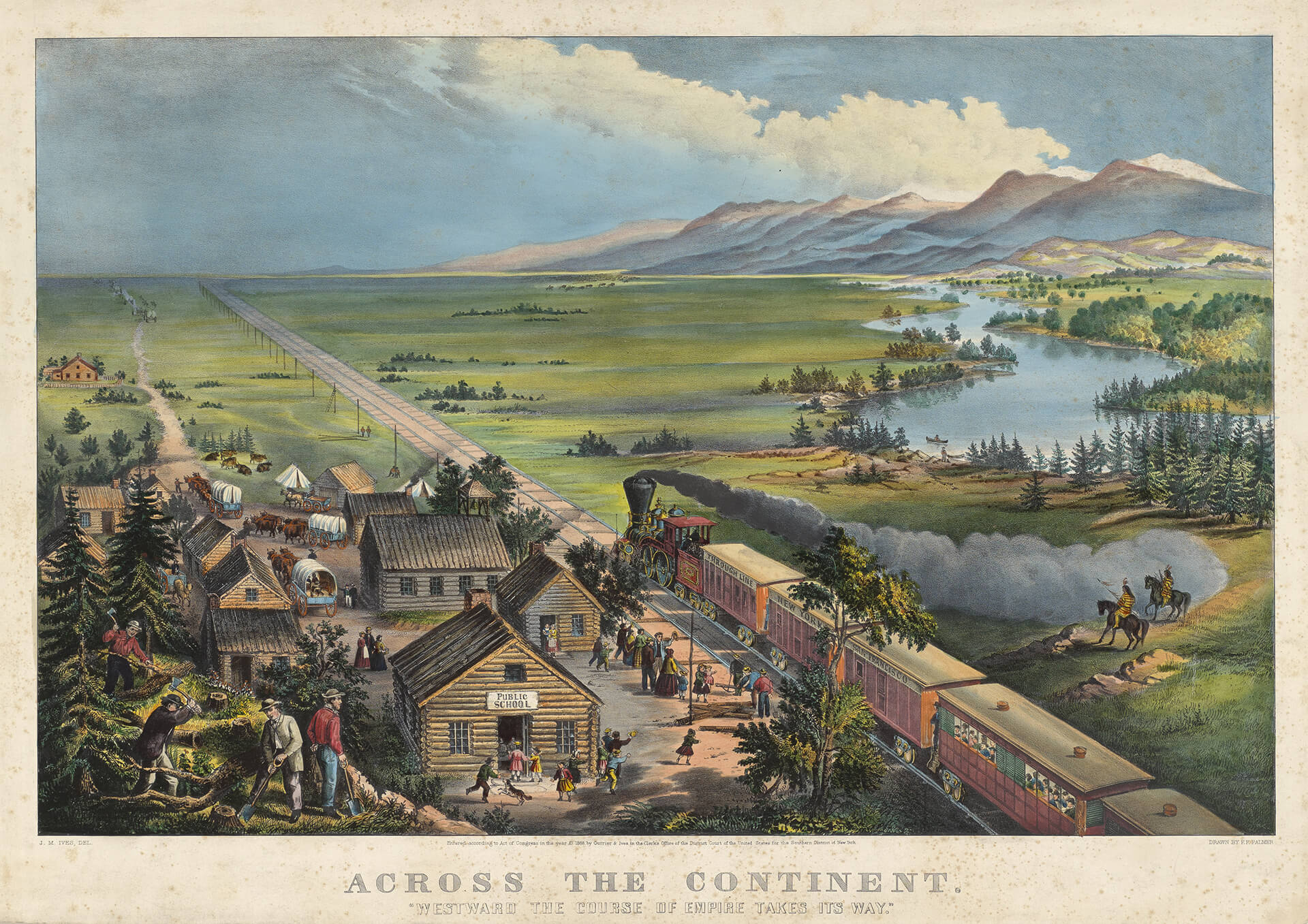
The canvas is divided by the railroad into two worlds. On the left, deforestation, settled agriculture and technological civilisation. Against it, nature and nomadic peoples. The locomotive is heading west, powering history toward white dominium and leaving Native Americans choking in its smoke. In their “technological backwardness,” indigenous peoples lacked the ability to compress time and space. As such, their role was to be conquered and cast aside.
The railroad in ‘Across the Continent’ symbolises a new and technocentric Progress narrative. In the modern era, European visualisations of the human journey were mutating from Providence, a sacred cosmology defined by the approach of the Last Judgment, to Progress, a secular historical time in continuous onward motion. The Progress narrative became infused with the idea of ‘economic infinity’ and the growth paradigm — the ideology of unending economic growth. In some renditions, a ‘ladder’ of stadial progress was identified, from barbarism to civilisation, such that the diversity of human populations could be hammered into a single temporal-economic chain.
Under the banner of Progress, abstract time and technological novelty became markers of modernity, defining the cities against the countryside and imperial powers against the colonies. It justified the claim that the richer and higher-tech nations (and ‘races’), indexed as history’s vanguard, should boss the rest, surgically redirecting their faces to the future. When the future is imagined as a dream of infinite progress, the past is necessarily deficient and the present must be continually realigned with the future through political intervention. This was a manifesto of time and technology, drumming capital’s rhythms into the colonial and post-colonial worlds — ‘the development project,’ ‘modernisation theory,’ and so forth.
References
Gerhard Dohrn-van Rossum (1996) History of the Hour: Clocks and Modern Temporal Orders, University of Chicago Press, p.287.
Giordano Nanni (2012) The Colonisation of Time: Ritual, Routine and Resistance in the British Empire, Manchester University Press. For a later period, nineteenth century Egypt, see Timothy Mitchell, Colonizing Egypt.
Giordano Nanni (2012) The Colonisation of Time: Ritual, Routine and Resistance in the British Empire, Manchester University Press, p.9.
- Giordano Nanni (2012) The Colonisation of Time: Ritual, Routine and Resistance in the British Empire, Manchester University Press, p.155.
Bibliography
Barbara Adam (2004) Time, Polity Press.
Gareth Dale (2019) ‘Davos and “capitalist time,”’ The Ecologist, 22 January, https://theecologist.org/2019/jan/22/davos-and-capitalist-time
Gerhard Dohrn-van Rossum (1996) History of the Hour: Clocks and Modern Temporal Orders, University of Chicago Press
Carolyn Merchant (1980) The Death of Nature: Women, Ecology and the Scientific Revolution, Harper & Row.
Giordano Nanni (2012) The Colonisation of Time: Ritual, Routine and Resistance in the British Empire, Manchester University Press
Jay Griffiths (2003) Pip Pip: A Sideways Look at Time, HarperCollins.
Edward Thompson (1967) ‘Time, Work-Discipline, and Industrial Capitalism,’ Past & Present, Volume 38, Issue 1, Pages 56–97, https://doi.org/10.1093/past/38.1.56
