
By Portia Jennings
Portia Jennings is currently studying a master’s in human rights at the University of Sussex. Her research focuses on migrants’ rights and the rights of precarious workers within neoliberal labour markets. She previously represented asylum seekers, victims of trafficking and modern slavery in legal claims against the UK Home Office.
Neoliberalism emerged as an economic and legal doctrine designed to maintain a colonial division of labour, economic and natural resources in the absence of colonial institutions. The 1938 Walter Lippmann colloquium is widely considered the birthplace of the neoliberal project (1). The colloquium was held in Paris and attended by many economic theorists who would later become influential to neoliberal ideology, including Friedrich Hayek and Wilhelm Röpke (2). The widespread economic repercussions of the Great Depression provoked a resolution among these economists to ensure states were protected from global economic instability through state legislation in service of the market (3). They abandoned the laissez-faire approach of classical liberalism, which saw the market as a machine best left to itself, in favour of a new liberalism – neoliberalism, in which the state played a central role in legislating to create the ideal economic conditions for a competitive market to prosper (4). The Mont Pèlerin Society (MPS), founded by Hayek in 1947, became central to the neoliberal project. During the 1940s, MPS members set about building the social and legal framework necessary for neoliberalism to thrive, in opposition to the expansion of socialism following World War II (5). This legal framework was based on an absolute right to private property that superseded the right to basic subsistence, realised through state welfare mechanisms, which the neoliberals believed endangered private ownership and therefore a free society (6). The neoliberal rejection of state welfare mechanisms informed its moral objective: to defeat the “totalitarian” and conflated threats of socialism, fascism and social welfare, which were considered an affront to human dignity and individual freedom (7). According to Röpke, ‘self-discipline, a sense of justice, honesty, fairness … [and] respect for human dignity’ were essential attributes for participation in a competitive market (8).
The principal objective of the neoliberal legal and moral project was to “civilise” non-European economies through creating an attractive climate for foreign investment and therefore development (9). In doing so, the neoliberals sought to maintain colonial power relations in the absence of colonial institutions. European and US representatives had celebrated the civilising power of commerce to facilitate “primitive” peoples’ participation in global trade at the Berlin Conference of 1884-85–the so-called “Scramble for Africa”–during which African states were divided among European powers (10). This ideology was also exemplified by the Mandates Section of the League of Nations, which oversaw colonial territories seized from Germany and the Ottoman Empire following World War I. Led by Swiss economist William Rappard, who later delivered the opening speech at the inaugural MPS conference, the Mandates Section ranked such territories including Iraq, Syria and Namibia according to whether they were considered sufficiently “developed” to self-govern (11). At Rappard’s request, the League ensured no mandate was transferred or terminated without the mandated government’s express guarantee that it would continue to respect the rights and contracts of private investors, which tied them to the demands of foreign investors even after achieving political independence (12). Inspired by this inherited discourse of civilisation through development, the neoliberals aimed to create an attractive climate for foreign investment in non-European states to guarantee European trade and so protect European traders’ rights to ‘life, dignity and property’ (13).
The MPS drew on this racialised notion of economic civilisation to justify its rejection of Third Worldism between the 1950s and 1970s, a movement among the countries of Asia, Africa and Latin America to challenge the inequitable impacts of colonialism and imperialism within geopolitical relations and the world economy. This was predominantly articulated through Third Worldist demands for a New International Economic Order (NIEO) to rectify economic inequalities wrought by colonialism (14). In its counterattack, the MPS argued that Third World states were unfit to govern themselves and their “undeveloped” social structures rendered them vulnerable to socialism which would stifle civilisational growth (15). Liberté Sans Frontières (LSF) was subsequently established to counter the NIEO movement by displacing accountability for economic inequality and destitution onto Third World governments. Founded by the French humanitarian organisation Médecins Sans Frontières, LSF framed itself as a centre for research on human rights and development issues (16). LSF maintained that reparations and aid from Western countries were not the solution to addressing poverty in Third World states, but rather the adoption of neoliberal economic policies which would promote development through self-reliance, to gradually lift formerly colonised peoples out of deprivation (17).
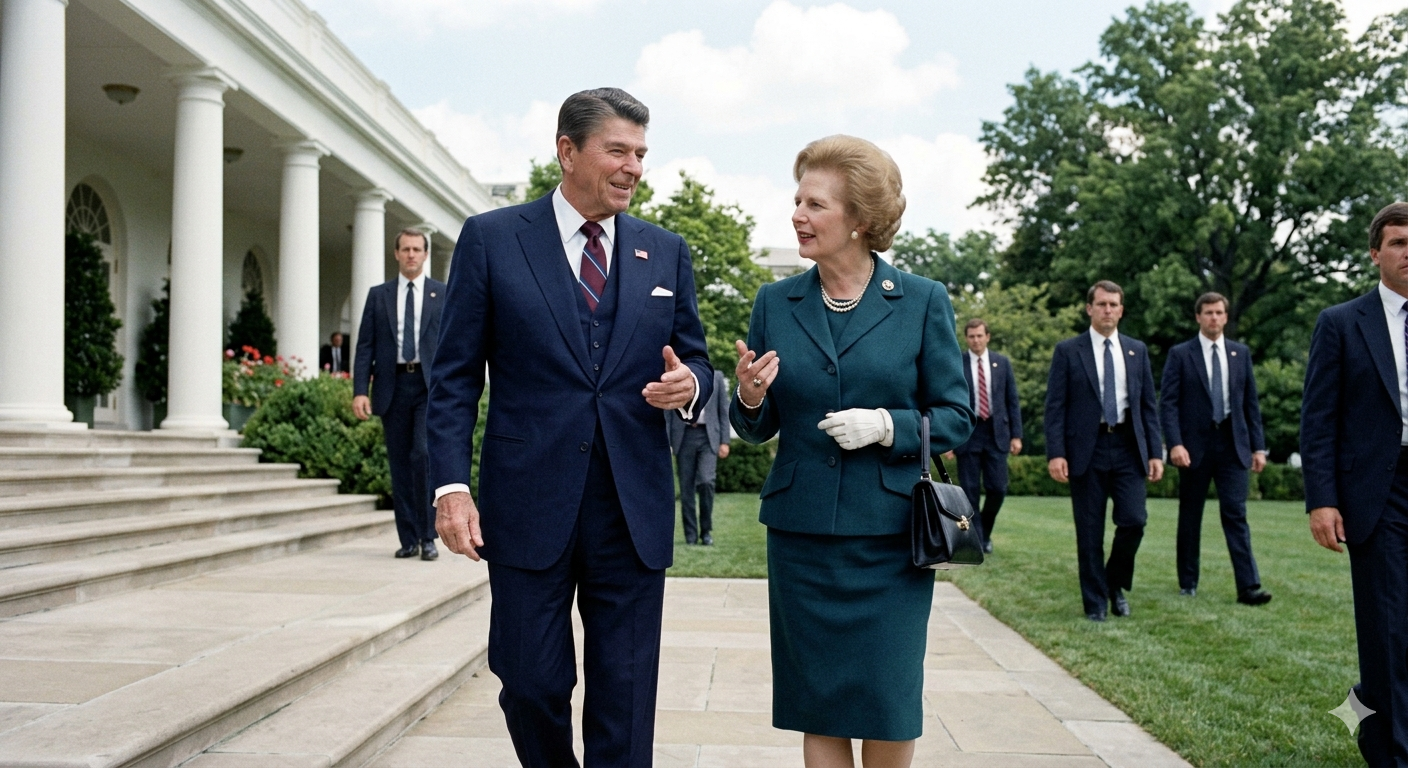
By the 1980s, the decolonisation efforts of Third World governments had been largely defeated by a neoliberal policy agenda spearheaded by the British and US heads of state, Margaret Thatcher and Ronald Reagan. These policies comprised trade liberalisation, deregulation, privatisation and cutbacks to state welfare provision, which were further justified as a means of tackling the threat of Soviet communism (18). The collapse of the Soviet Union in the early 1990s sparked the international expansion of neoliberalism as an economic orthodoxy. The World Trade Organisation (WTO) and the International Monetary Fund (IMF) have since been mandated to impose a global set of rules, whose principal objective is to remove barriers to the flow of international trade (19). The Group of Seven (G7) comprising the most influential capitalist powers including the US, Europe and Japan, have collaborated to shape a global financial and market system which exerts pressure on states to liberalise trade, privatise industries and curtail social expenditure to protect the rights of private investors and corporations, effectively restricting states’ sovereignty in respect of their economic and natural resources (20). Those who fail to do so are labelled ‘rogue nations’ and penalised through economic sanctions, coercion or military force (21).
References
- Ntina Tzouvala, ‘Neoliberalism as Legalism: International Economic Law and the Rise of the Judiciary’, in The Politics of Legality in a Neoliberal Age, ed. Ben Golder and Daniel McLoughlin, 1st edn (New York: Routledge, 2017), 123.
- Tzouvala, ‘Neoliberalism as Legalism’, 123.
- Tzouvala, 122.
- Wilhelm Röpke, The Social Crisis of Our Time (The University of Chicago, 1950), 228, quoted in Tzouvala, 124.
- Jessica Whyte, ‘Powerless Companions or Fellow Travellers? Human Rights and the Neoliberal Assault on Post-Colonial Economic Justice’, Radical Philosophy, no. 202 (2018): 16.
- Warren Montag, ‘War and the Market: The Place of the Global South in the Origins of Neo-Liberalism’, The Global South 3, no. 1 (2009): 136–37.
- Jessica Whyte, The Morals of the Market: Human Rights and the Rise of Neoliberalism (London: Verso, 2019), 35, http://ebookcentral.proquest.com/lib/suss/detail.action?docID=5897301.
- Wilhelm Röpke, A Humane Economy: The Social Framework of the Free Market, transl. Elizabeth Henderson (Chicago: Institute for Philosophical and Historical Studies, 1961), 125, quoted in Whyte, The Morals of the Market, 34.
- Whyte, The Morals of the Market, 43.
- Jessica Whyte, The Morals of the Market, 39.
- Whyte, The Morals of the Market, 41.
- Whyte, The Morals of the Market, 43.
- Gerrit W. Gong, The Standard of ‘Civilization’ in International Society (Oxford: Clarendon, 1984), 36, quoted in Whyte, The Morals of the Market, 39.
- Whyte, ‘Powerless Companions or Fellow Travellers?’, 14.
- Coleman, Struggles for the Human, 40.
- Jessica Whyte, ‘Powerless Companions or Fellow Travellers?’, 13.
- Whyte, ‘Powerless Companions or Fellow Travellers?’, 20.
- Joel Bakan, The Corporation: The Pathological Pursuit of Profit and Power (Free Press, 2004), 21.
- Joel Bakan, The Corporation: The Pathological Pursuit of Profit and Power, 22.
- David Harvey, ‘Neoliberalism as Creative Destruction’, The Annals of the American Academy of Political and Social Science 610 (2007): 37.
- David Harvey, ‘Neoliberalism as Creative Destruction’, 37.
